
 Español
 Pусский
 Français
 العربية


bending resistance tester
A bending resistance tester is a specialized instrument used to evaluate the flexibility, durability, and structural integrity of materials when subjected to repeated or controlled bending forces. It is widely applied in quality control, research and development, and material performance testing across industries such as packaging, paper, textiles, plastics, leather, rubber, and composites. The primary purpose of this equipment is to determine how well a sample can withstand bending without cracking, breaking, losing strength, or showing permanent deformation.The basic working principle of a bending resistance tester is to apply a specified bending motion or load to a material sample and measure its response over time. Depending on the design, the tester may perform repeated flexing cycles or a single bending operation under controlled angles, speeds, and force conditions. The number of cycles a material can endure before failure, as well as any changes in appearance or mechanical properties, provides valuable data for assessing product quality and service life.A typical bending resistance tester consists of a test frame, clamping fixtures, a loading or bending mechanism, a control system, and a display or data output unit. The sample is securely fixed in position, and the machine applies bending according to preset test parameters. Modern models often feature digital controls, touch-screen interfaces, programmable test settings, and automatic result recording. Some advanced instruments can store test data, calculate averages, and generate reports for more efficient analysis.Bending resistance testing is important because many materials experience flexing during actual use. For example, packaging materials may be folded and handled repeatedly, paper products may be bent during printing or transportation, and plastic or rubber parts may be exposed to continuous motion in applications. By simulating these conditions in a laboratory environment, the tester helps manufacturers predict product performance, improve design, and reduce the risk of failure in real-world use.The results obtained from a bending resistance tester can be used to compare different materials, optimize thickness or composition, and verify compliance with technical standards. It also helps identify weaknesses such as brittleness, poor elasticity, internal defects, or inadequate manufacturing processes. In many cases, repeated bending tests are especially useful for products expected to maintain performance after long-term use or frequent handling.In addition to its practical value, the bending resistance tester contributes to product consistency and customer satisfaction. Reliable testing ensures that materials meet required mechanical properties before they are released to the market. This reduces waste, lowers production losses, and supports continuous improvement in material engineering.Overall, a bending resistance tester is an essential tool for measuring the bending performance of materials. With accurate testing, stable operation, and clear results, it plays a vital role in material evaluation, product development, and quality assurance.
Products
Category:
-
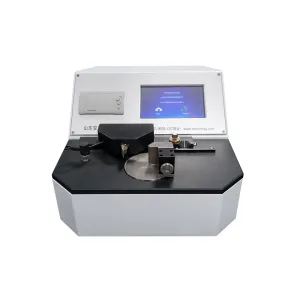
Digital Bending Stiffness Tester
Category: Paper Testing InstrumentsBrowse number: 358Number:Release time: 2026-07-10 08:50:01The Digital Bending Stiffness Tester is a professional instrument for measuring the bending stiffness of paper and paperboard. It is suitable for static bending stiffness determination of various papers, paperboards, and packaging materials. As a pioneer in adopting an LCD curve-display human-machine interface, this multi-functional tester allows the bending angle to be freely set between 1° and 90°, covering the standard 7.5° and 15° tests as well as the 90° crease stiffness test. The bending length is selectable from 5 to 50 mm in fixed steps (manual version) or infinitely adjustable from 5 to 60 mm (automatic version), and the test time can be set from 3 to 35 seconds. The instrument features automatic zeroing, real-time force-time-angle curve display, automatic measurement statistics, and printing. After testing, it returns to the initial position at high speed with an adjustable return speed of 0.55-20°/s. All performance parameters comply with GB/T 23144 and GB 22364-2018 standards, making it a standard configuration instrument for bending stiffness testing in paper mills, packaging industries, research institutes, and quality inspection agencies.
News
Category:
No search results found!
Case
Category:
No search results found!
Video
Category:
No search results found!
Download
Category:
No search results found!
Job
Category:
No search results found!
Featured Products
No search results found!



 Phone
Phone