
 Español
 Pусский
 Français
 العربية


compression tester
A compression tester is a precision instrument used to measure the compressive strength, deformation behavior, and load-bearing performance of materials under pressure. It is widely applied in laboratories, quality control departments, manufacturing facilities, and research institutions to evaluate how a material responds when a force is applied vertically or in a squeezing direction. By simulating real-world pressure conditions, a compression tester helps determine whether a product or material can withstand the stresses it may encounter during use, storage, shipping, or construction.The basic principle of a compression tester is to apply controlled force to a specimen until a specified limit is reached or the sample fails. During the test, the machine records key data such as maximum load, compression distance, deformation, stiffness, and breaking point. These measurements provide valuable information about the mechanical properties of the sample. Depending on the model, a compression tester may operate manually, semi-automatically, or fully automatically, with digital control systems that improve accuracy and repeatability.Compression testers are used on a wide range of materials, including plastics, metals, rubber, foam, cardboard, concrete, packaging materials, springs, and electronic components. In the packaging industry, they are often used to test boxes, cartons, and containers to ensure they can protect products during transportation. In the construction field, they are essential for evaluating building materials such as cement blocks and concrete samples. In product development, they help engineers compare different designs and improve structural performance.Modern compression testers are typically equipped with advanced features such as digital displays, computer software, programmable test speeds, and data storage functions. Some models allow users to create customized test methods according to specific international standards. Safety features are also important, including overload protection, emergency stop buttons, and protective covers, which help prevent damage to both the operator and the machine.The accuracy of a compression tester depends on proper calibration, specimen preparation, and test conditions. Samples should be prepared according to relevant standards to ensure consistent results. Temperature, humidity, and loading speed can also influence test outcomes, so these factors must be controlled when necessary. Regular maintenance and calibration are necessary to keep the equipment reliable and precise.Overall, a compression tester is an essential tool for material evaluation and product quality assurance. It helps manufacturers and researchers understand material strength, improve product design, reduce failure risks, and meet industry standards. By providing accurate and repeatable results, it plays an important role in ensuring safety, durability, and performance across many industries.
Products
Category:
-
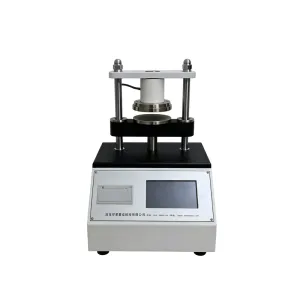
Touchscreen Compression Tester
Category: Paper Testing InstrumentsBrowse number: 288Number:Release time: 2026-07-09 09:33:16The Touchscreen Compression Tester is a precision mechanical testing instrument designed for paper, paperboard, and corrugated board. It is capable of performing Ring Crush Test (RCT), Edge Crush Test (ECT), Pin Adhesion Test (PAT), Flat Crush Test (FCT), and compressive strength testing of paper bowls and tubes. The instrument complies with Chinese national standards including GB/T 2679.8, GB/T 6546, GB/T 6548, GB/T 22874, and GB/T 27591. It offers a force measurement range of 60-3000 N with a resolution of 1 N and accuracy of ±1%, and a test speed of 12.5±2.5 mm/min. The distance between platens is 0-70 mm (customizable), and the platen diameter is 135 mm. The mechanical design features a worm gear reducer and dual linear bearings to ensure stable motion and platen parallelism. A touchscreen control system stores multiple test data and automatically calculates statistics including maximum, minimum, average, standard deviation, and coefficient of variation, with data printing capability. This instrument is a standard configuration for QC labs, research institutes, and inspection agencies evaluating the compressive properties of paper-based packaging materials.
News
Category:
No search results found!
Case
Category:
No search results found!
Video
Category:
No search results found!
Download
Category:
No search results found!
Job
Category:
No search results found!
Featured Products
No search results found!



 Phone
Phone