
 Español
 Pусский
 Français
 العربية


laboratory sheet mold
A laboratory sheet mold is a precision tool used to produce flat, uniform test sheets from a variety of materials, including paper pulp, polymer blends, fibers, composites, and other lab-scale samples. It is commonly used in research, quality control, and product development to create small sheets with consistent thickness and surface characteristics for further testing and comparison. Because laboratory work often requires highly repeatable results, the mold is designed to provide accurate formation conditions and reliable sample preparation.The structure of a laboratory sheet mold is usually simple but carefully engineered. It typically consists of a forming frame, a base, a screen or mesh section, and related drainage and pressing components. During operation, a slurry or prepared suspension is poured into the mold, where water or liquid passes through the mesh while solid particles remain evenly distributed on the surface. This process helps form a uniform wet sheet. After drainage, the sheet may be transferred for pressing, drying, or conditioning depending on the material being tested.One of the main advantages of a laboratory sheet mold is its ability to produce standardized samples. In laboratory testing, sample consistency is essential because variations in thickness, density, or formation can affect the accuracy of results. With a properly designed mold, users can prepare sheets that closely match one another, improving the reliability of measurements such as tensile strength, burst strength, absorption, opacity, surface roughness, and other physical properties. This makes the mold especially valuable in comparative studies and product formulation trials.Laboratory sheet molds are available in different sizes and configurations to suit different testing needs. Some models are designed for manual operation, while others are integrated into semi-automatic or fully automatic sheet-making systems. Materials of construction are often selected for durability, corrosion resistance, and ease of cleaning. Stainless steel is commonly used because it offers strength, stability, and resistance to moisture and chemicals. The screen or mesh must also be fine and uniform to ensure proper drainage and even sheet formation.In addition to accuracy, ease of use is another important feature. A good laboratory sheet mold should allow quick assembly, smooth operation, and simple cleaning between tests. Since laboratories often handle multiple sample types in one day, the ability to switch easily between runs helps save time and reduce contamination risk. A well-maintained mold also improves long-term performance and helps ensure that each sheet is produced under the same conditions.Laboratory sheet molds are widely used in educational institutions, material science laboratories, paper testing facilities, and industrial research centers. They support development work by allowing researchers to evaluate new recipes, compare raw materials, and optimize process conditions before full-scale production. By enabling controlled sample preparation, the mold plays an important role in accurate analysis and efficient experimentation.Overall, a laboratory sheet mold is an essential piece of equipment for anyone who needs consistent, high-quality sheet samples in a controlled laboratory environment. Its precision, durability, and versatility make it a valuable tool for testing, research, and development across many fields.
Products
Category:
-
Standard Sheet Former
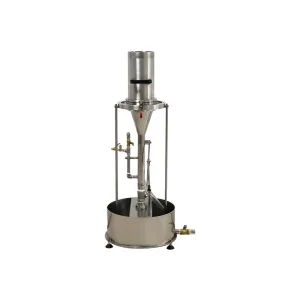
Category: Pulp Preparation & Sheet Forming EquipmentBrowse number: 584Number:Release time: 2026-07-06 14:16:42The Standard Sheet Former is a manual laboratory sheet-making apparatus designed in strict compliance with ISO 5269/1, TAPPI T205, SCAN C26, and PAPTAC C4 international standards. It is intended for the preparation of standard circular paper samples of φ159 mm diameter from pulp fibers that have undergone cooking, beating, screening, and defibering. These standardized samples are then used for evaluating the physical, mechanical, and optical properties of paper and paperboard. The unit features an 8 L pulp tank with a height of 400 mm, a 150-mesh forming wire, and a drop-leg height of 800 mm that delivers a drainage time of less than 3.6 seconds for rapid and uniform sheet formation. With a net weight of 80 kg and a robust construction, it provides intuitive operation and excellent reproducibility. It is the standardized sample preparation instrument for quality control, R&D, and academic teaching in papermaking and fiber material science.
News
Category:
No search results found!
Case
Category:
No search results found!
Video
Category:
No search results found!
Download
Category:
No search results found!
Job
Category:
No search results found!
Featured Products
-
NEWS
Standard Sheet Former
Learn more



 Phone
Phone