
 Español
 Pусский
 Français
 العربية


paper cleanliness tester
A paper cleanliness tester is an instrument used to evaluate the level of cleanliness in paper and paperboard materials by detecting and analyzing visible and invisible contaminants. It plays an important role in quality control for paper manufacturing, printing, packaging, and other industries where surface purity and material consistency are critical. The tester helps identify defects such as dust, dirt, fibers, specks, ink residues, and other foreign particles that may affect the appearance, performance, and usability of the final product.The main purpose of a paper cleanliness tester is to provide a reliable and objective assessment of paper surface quality. During production, paper can be contaminated by raw materials, processing equipment, environmental particles, or handling conditions. Even a small amount of contamination may lead to problems such as printing defects, weak adhesion, poor coating performance, or customer complaints. By using a cleanliness tester, manufacturers can detect these issues early and take corrective action before the product reaches the market.A typical paper cleanliness tester works by scanning the surface or analyzing samples under controlled lighting and imaging conditions. Advanced models may use high-resolution cameras, optical sensors, and image processing technology to detect and measure contamination particles. The device can classify impurities by size, shape, number, and distribution, allowing users to understand the severity and pattern of contamination. Some systems also generate detailed reports with graphs and data summaries, making it easier to compare different batches and monitor long-term quality trends.This instrument is widely used in paper mills, laboratories, inspection departments, and research facilities. It is especially valuable for producing high-grade writing paper, printing paper, food-grade packaging paper, and special functional paper products. In these applications, even minor defects can reduce product value or cause processing difficulties. A paper cleanliness tester supports consistent quality by helping operators maintain strict standards throughout production.Another advantage of the paper cleanliness tester is its ability to improve efficiency and reduce waste. Manual inspection can be slow, subjective, and inconsistent, especially when large quantities of paper must be tested. Automated testing provides faster results and reduces human error. This allows production teams to respond quickly, adjust processes, and minimize the number of rejected products. Over time, this contributes to lower production costs and better resource utilization.Modern paper cleanliness testers are designed to be user-friendly, accurate, and efficient. They often include intuitive software interfaces, customizable test settings, and easy data storage functions. Operators can set thresholds according to specific quality requirements and obtain repeatable results under standardized conditions. Some models are also built for durability and continuous operation in industrial environments.In summary, a paper cleanliness tester is an essential quality assurance tool for the paper industry. It helps detect contamination, improve product consistency, and support higher production standards. By providing accurate and objective measurements, it ensures that paper products meet both technical requirements and customer expectations.
Products
Category:
-
Paper Dirt Tester
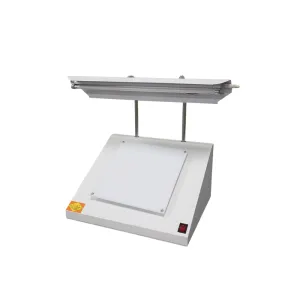
Category: Paper Testing InstrumentsBrowse number: 218Number:Release time: 2026-08-05 11:01:02The Paper Dirt Tester is a specialized inspection instrument designed and manufactured in accordance with GB/T 1541-1989 (Paper and board — Determination of dirt). It is primarily used for the quantitative determination of surface dirt on various types of paper and paperboard. The instrument uses a 20W standard fluorescent lamp with a 60° irradiation angle to simulate standard illumination conditions, ensuring consistency and comparability of the observation environment. The worktable has an effective area of 0.0625 m² and can rotate 360°, facilitating comprehensive observation of large-area specimens from all directions. It is equipped with standard dirt comparison charts ranging from 0.05 to 5.0 mm, allowing quick visual determination of dirt grade by comparing fiber bundles and other impurities on the specimen surface with the standard charts. The overall dimensions are 750×350×500 mm with a weight of approximately 12.5 kg. The structure is robust and operation is intuitive. This instrument is a standard configuration device for paper surface quality inspection, cleanliness evaluation, and product grade assessment in paper mills, quality inspection agencies, packaging and printing plants, and research institutions.
News
Category:
No search results found!
Case
Category:
No search results found!
Video
Category:
No search results found!
Download
Category:
No search results found!
Job
Category:
No search results found!
Featured Products
No search results found!



 Phone
Phone