
 Español
 Pусский
 Français
 العربية


pneumatic press
A pneumatic press is a type of industrial machine that uses compressed air to generate force for shaping, assembling, cutting, or compressing materials. It is widely used in manufacturing because it offers a combination of speed, precision, and ease of control. Unlike hydraulic systems, which rely on fluid pressure, a pneumatic press operates through air pressure, making it generally cleaner, simpler to maintain, and more suitable for tasks that require rapid repetitive motion.The basic working principle of a pneumatic press is straightforward. Compressed air is supplied to a cylinder, where it pushes a piston downward or upward depending on the design. This movement creates mechanical force that is transferred to a ram or tool head. The force can then be applied to a workpiece for punching holes, pressing components together, stamping, riveting, forming soft metals, or testing material strength. Because air can be controlled accurately through valves and regulators, the press can deliver consistent motion and adjustable force.One of the main advantages of a pneumatic press is its high operating speed. Air cylinders respond quickly, allowing the machine to complete repeated cycles in a short time. This makes it especially useful in production lines where efficiency is important. Another benefit is the simplicity of the system. Pneumatic presses usually have fewer moving parts than hydraulic presses, which can reduce maintenance needs and lower the risk of oil leaks. In addition, compressed air is generally safe and available in many industrial environments, which makes pneumatic systems convenient to integrate into existing operations.Pneumatic presses are used in many industries. In electronics, they may be used for precision assembly or small component insertion. In automotive and metalworking applications, they can assist with light stamping, bending, or part alignment. In packaging and plastics, they are useful for sealing, cutting, and compressing materials. They are also common in laboratories and quality control departments for sample preparation and testing. Depending on the design, a pneumatic press can be operated manually, semi-automatically, or fully automatically.Safety is an important feature of pneumatic press design. Many machines include protective guards, two-hand controls, emergency stop buttons, and pressure regulators to prevent accidental operation or excessive force. Since compressed air can store energy, proper installation and regular inspection are necessary to ensure stable performance. Operators should be trained to use the machine correctly and to keep hands and tools away from the pressing area during operation.Overall, a pneumatic press is a versatile and efficient machine that plays an important role in modern production. Its fast cycle time, clean operation, and relatively simple structure make it a practical choice for many tasks requiring controlled pressing force. Whether used for assembly, forming, or testing, the pneumatic press remains an important tool in industrial automation and manufacturing.
Products
Category:
-
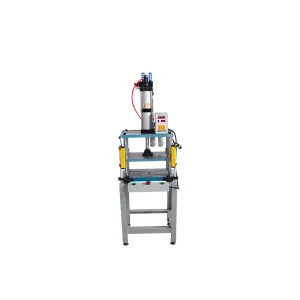
Pneumatic Sheet Press
Category: Pulp Preparation & Sheet Forming EquipmentBrowse number: 311Number:Release time: 2026-07-08 09:31:08The Pneumatic Sheet Press is a standard specimen preparation device specifically designed for pulp and paper laboratories, fully compliant with the QB/T 3703-1999 standard (Preparation of laboratory sheets + conventional sheet former method). This equipment adopts a pneumatic control system with an adjustable working pressure range of 0-0.9 MPa, a standard pressing pressure of 0.414 MPa, a cylinder diameter of 63 mm, and a nominal pressing force of 45-80 Kg. The pressing platen accommodates specimens up to 310×310×200 mm. By applying controlled pneumatic pressure, it rapidly removes water from wet handsheets, significantly increasing their density, smoothness, and physical strength. The unit features a compact and lightweight structure with overall dimensions of 570×400×900 mm and comes complete with an air compressor for ready-to-use operation. It is an indispensable step in the standard handsheet preparation workflow, delivering properly pressed specimens for subsequent physical property testing.
News
Category:
No search results found!
Case
Category:
No search results found!
Video
Category:
No search results found!
Download
Category:
No search results found!
Job
Category:
No search results found!
Featured Products
No search results found!



 Phone
Phone