
 Español
 Pусский
 Français
 العربية


puncture resistance tester
A puncture resistance tester is a precision testing instrument used to evaluate the ability of a material to withstand penetration by a sharp or pointed object. It is widely applied in industries where packaging integrity, material durability, and product protection are critical. Common test materials include plastic films, laminated sheets, paper-based packaging, foams, textiles, nonwoven fabrics, rubber, and thin composite materials. By simulating real-world puncture conditions, the tester helps manufacturers assess whether a material can resist damage during handling, transport, storage, and use.The working principle of a puncture resistance tester is straightforward. A test sample is clamped securely in place, and a probe or puncture needle is driven toward the material at a controlled speed and force. As the probe presses against the sample, the instrument records the maximum force required to puncture the specimen. This value is used to determine the puncture resistance of the material. Depending on the design, the tester may also measure displacement, energy absorption, and deformation behavior before failure. These additional data provide a more complete understanding of the sample’s mechanical performance.A puncture resistance tester typically consists of a rigid frame, a sample holding fixture, a loading system, a puncture probe, and a digital control or display unit. The frame ensures stability and consistent alignment during testing. The fixture holds the specimen flat and prevents slipping or stretching. The loading system, which may be motor-driven or manually operated, applies force in a precise and repeatable manner. The probe is designed according to relevant test standards and can vary in shape, size, and tip geometry depending on the application. Modern instruments often feature touchscreen operation, automatic data collection, and software for statistical analysis and report generation.This tester offers several advantages. It provides accurate and repeatable results, helping users compare different materials objectively. It also supports quality control during production, allowing defective or underperforming materials to be identified early. In research and development, the instrument helps engineers improve product design by testing new formulations, structures, and thicknesses. In the packaging industry, puncture resistance testing is especially important for flexible packaging used in food, pharmaceuticals, electronics, and industrial products, where even small damage can lead to leakage, contamination, or product failure.Different test standards may be used depending on the material and region, so proper test settings and specimen preparation are essential. Factors such as sample thickness, temperature, humidity, probe shape, and clamping pressure can influence the results. For this reason, testing conditions should be carefully controlled to ensure reliable and comparable data.In summary, a puncture resistance tester is an essential tool for evaluating material toughness and durability. It helps ensure that products meet performance requirements and can survive practical use conditions. By delivering objective and repeatable measurements, it plays an important role in quality assurance, product development, and material research.
Products
Category:
-
Puncture Tester
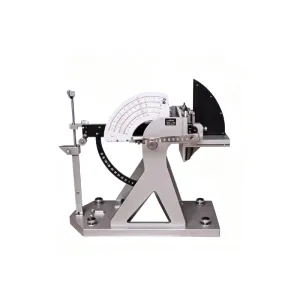
Category: Paper Testing InstrumentsBrowse number: 271Number:Release time: 2026-07-13 09:56:26The Puncture Tester is a standard instrument specifically designed for measuring the puncture resistance of corrugated board. It is widely used in quality inspection at board and box manufacturing plants, material research at scientific institutions, and performance evaluation at commodity inspection agencies. The instrument is designed and manufactured in accordance with ISO 3036 (Determination of puncture resistance of board) and GB/T 2679.7 (Determination of puncture resistance of paperboard). It features a measuring range of 0-48 J, equipped with four scales—A (0-6 J), B (0-12 J), C (0-24 J), and D (0-48 J)—with the smallest graduation of 0.05 J, meeting testing needs from thin board to heavy-duty corrugated board. The instrument includes a quick-clamping mechanism, an operating handle with automatic return function, and comprehensive safety protection features for safe and reliable operation. With overall dimensions of 900×800×410 mm and a weight of approximately 100 kg, it is a robust, durable, and indispensable testing device for puncture resistance evaluation and quality control in the board and box industry.
News
Category:
No search results found!
Case
Category:
No search results found!
Video
Category:
No search results found!
Download
Category:
No search results found!
Job
Category:
No search results found!
Featured Products
No search results found!



 Phone
Phone