
 Español
 Pусский
 Français
 العربية


puncture tester
A puncture tester is a specialized testing device used to evaluate the resistance of a material, product, or package against penetration by a pointed object. It is widely applied in industries such as packaging, textiles, rubber, plastics, medical products, and protective materials. The main purpose of a puncture tester is to measure how much force or energy is required to puncture a sample, helping manufacturers assess durability, safety, and overall performance.The basic working principle of a puncture tester is straightforward. A sample is securely fixed in a clamping system, and a probe, needle, or pointed striker is driven toward the sample at a controlled speed. As the probe presses against the material, the machine records the force, displacement, or energy needed to cause puncture. These measurements provide valuable data about the material’s strength and structural integrity. Depending on the design, the tester may operate mechanically, electronically, or through a combination of both.Puncture testers are often equipped with high-precision load cells and motion control systems to ensure accurate and repeatable results. Many models include digital displays, computer software, and data storage functions, allowing operators to monitor test curves in real time and analyze results afterward. The test parameters can usually be adjusted according to different standards or product requirements, such as probe shape, test speed, clamping force, and sample size. This flexibility makes the equipment suitable for a wide range of testing applications.In packaging applications, a puncture tester is commonly used to evaluate cartons, corrugated board, films, and flexible packaging materials. It helps determine whether a package can withstand rough handling, pressure, or accidental contact during transportation and storage. For textiles and protective fabrics, puncture testing is used to assess tear resistance and protective performance. In the medical and industrial fields, it can be used to test gloves, membranes, and safety barriers where puncture resistance is critical.One of the key advantages of using a puncture tester is its ability to provide objective and standardized results. Instead of relying on visual inspection or subjective judgment, manufacturers can obtain quantitative data that supports quality control, product development, and material comparison. This is especially important when designing products that must meet safety regulations or industry standards. Regular puncture testing also helps identify weaknesses in material formulation, thickness, structure, or manufacturing process.Modern puncture testers are designed for ease of operation, high accuracy, and long-term reliability. They often feature protective enclosures, automatic return functions, and user-friendly interfaces to improve safety and efficiency. Some advanced systems can perform multiple test types and generate detailed reports for laboratory or production use.Overall, a puncture tester is an essential instrument for evaluating material resistance to penetration. By delivering precise and repeatable test results, it supports better product design, improved quality control, and greater confidence in material performance across many industries.
Products
Category:
-
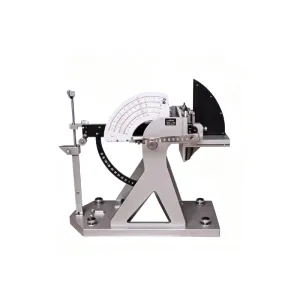
Puncture Tester
Category: Paper Testing InstrumentsBrowse number: 266Number:Release time: 2026-07-13 09:56:26The Puncture Tester is a standard instrument specifically designed for measuring the puncture resistance of corrugated board. It is widely used in quality inspection at board and box manufacturing plants, material research at scientific institutions, and performance evaluation at commodity inspection agencies. The instrument is designed and manufactured in accordance with ISO 3036 (Determination of puncture resistance of board) and GB/T 2679.7 (Determination of puncture resistance of paperboard). It features a measuring range of 0-48 J, equipped with four scales—A (0-6 J), B (0-12 J), C (0-24 J), and D (0-48 J)—with the smallest graduation of 0.05 J, meeting testing needs from thin board to heavy-duty corrugated board. The instrument includes a quick-clamping mechanism, an operating handle with automatic return function, and comprehensive safety protection features for safe and reliable operation. With overall dimensions of 900×800×410 mm and a weight of approximately 100 kg, it is a robust, durable, and indispensable testing device for puncture resistance evaluation and quality control in the board and box industry.
News
Category:
No search results found!
Case
Category:
No search results found!
Video
Category:
No search results found!
Download
Category:
No search results found!
Job
Category:
No search results found!
Featured Products
No search results found!



 Phone
Phone