
 Español
 Pусский
 Français
 العربية


tissue lint tester
A tissue lint tester is a specialized laboratory instrument used to evaluate the amount of lint or loose fibers released by tissue products during use or handling. It plays an important role in quality control for paper tissue manufacturing, helping producers assess whether facial tissues, toilet tissues, napkins, or other soft paper products meet required cleanliness, performance, and appearance standards.The main purpose of a tissue lint tester is to simulate conditions that may cause a tissue sheet to shed fibers. During production, storage, transportation, and consumer use, tissue products can generate lint due to their fiber structure, basis weight, softness, and bonding characteristics. Excessive linting may affect product comfort, reduce perceived quality, and create problems in applications where cleanliness is important. By measuring lint release, manufacturers can improve product formulation and processing conditions.A typical tissue lint tester is designed with a testing chamber or rotating system that subjects the tissue sample to mechanical action. This action may involve rubbing, tumbling, air movement, or other forms of stress that imitate real usage. The released lint is then collected on a filter, adhesive surface, or detection medium. Depending on the design, the tester may quantify lint by weighing collected material, analyzing particle count, or comparing the result against a visual grading scale.The test process generally begins by preparing a tissue sample according to standard dimensions. The sample is placed in the testing area, and the instrument is operated for a set time or number of cycles. After the test is complete, the amount of lint generated is evaluated. Some advanced models use sensors, digital imaging, or automated analysis to improve accuracy and repeatability. This makes it easier to compare different tissue grades, raw materials, or production batches.A tissue lint tester is valuable for several reasons. First, it helps manufacturers maintain consistent product quality. Second, it supports research and development by allowing engineers to study the effects of fiber type, creping, embossing, and wet strength additives on lint behavior. Third, it can assist in identifying defects in the production process, such as poor fiber bonding or excessive dust generation. In this way, the tester contributes to both product improvement and customer satisfaction.The device is commonly used in laboratories, inspection departments, and production control environments. It is especially useful for premium tissue products, where softness must be balanced with strength and low linting. Because tissue products are often used on skin, around food, or in hygiene-sensitive settings, controlling lint is important for safety and comfort.In summary, a tissue lint tester is an essential instrument for evaluating fiber shedding in tissue paper products. It provides objective data on linting performance, supports quality assurance, and helps manufacturers produce cleaner, more reliable, and higher-quality tissue products.
Products
Category:
-
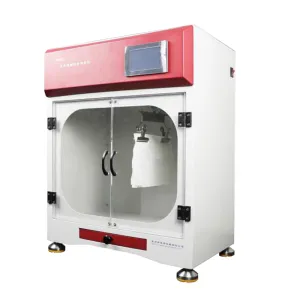
Tissue Lint Tester
Category: Tissue & Hygiene Product Testing InstrumentsBrowse number: 250Number:Release time: 2026-07-23 10:27:26The Tissue Lint Tester is a specialized instrument designed for testing the linting tendency of tissue paper and tissue base paper, fully compliant with the GB/T 20810-2018 standard (Tissue paper, including tissue base paper). It uses a servo motor-driven reciprocating mechanism to simulate the friction and shaking that tissue paper undergoes during actual use, quantitatively evaluating the degree of surface linting. The instrument features touchscreen control, with an adjustable oscillation frequency of 60-180 r/min, an oscillation distance of 100±5 mm, and a settable test cycle count from 2 to 999,999 times to meet different testing parameter requirements. The machine operates smoothly and quietly, with a built-in thermal micro-printer for direct report printing. It is a standard configuration device for linting testing and quality control in tissue paper manufacturing, quality inspection agencies, and research institutions.
News
Category:
No search results found!
Case
Category:
No search results found!
Video
Category:
No search results found!
Download
Category:
No search results found!
Job
Category:
No search results found!
Featured Products
No search results found!



 Phone
Phone